SP51/13/CO-02

SpaceX

ACTIVE
CLASS
COMPANY
FILED
2013
DOCUMENTS
05
STATUS
ACTIVE

Filed in 2013 as one promising contractor among several. The assessment has not aged equally.

DOCUMENT30 MAY 2013SpaceX

Let's take a closer look at SpaceX. If the fact that it was founded in 2002 by Elon Musk (aka "the real Tony Stark") doesn't guarantee it success (he did after all start PayPal and Tesla Motors amongst others!), the numbers do most of the talking: with nearly 50 launches on its manifest, representing more than $4 billion in contracts, SpaceX continues to push the boundaries of space technology down at 1 Rocket Road in California where their 3000 staff are headquartered. A year ago, SpaceX successfully launched a private unmanned spaceship on a mission to the International Space Station (ISS), which made a bold statement that one of their main objectives is to offer a viable alternative to the now retired space shuttle program. With that effort, SpaceX's Dragon capsule became the first commercial spacecraft to attach to the space station, deliver cargo, and return to earth. The company has this month also signed a three-year lease with Spaceport America to test their Grasshopper reusable rocket, meaning they can test at higher altitudes, as well as Sir Richard Branson having neighbours in New Mexico. Furthermore, plans are underway though for a commercial launch facility in Texas to keep the action closer to home. SpaceX is on a mission. As Elon Musk recently said at SXSW:

"I'd like to die on Mars, just not on impact"
DOCUMENT16 JUN 2013Dragon

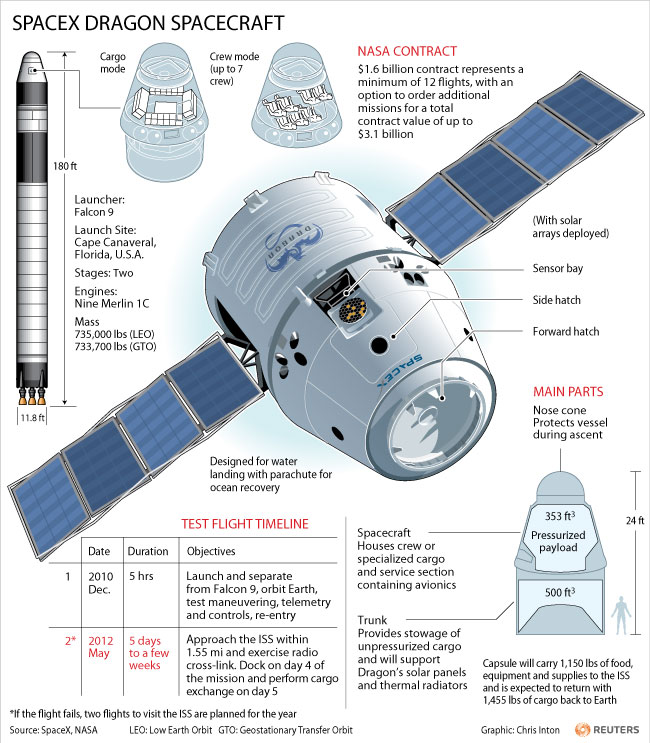
In May of last 2012, Dragon became the first commercial spacecraft to successfully rendezvous and connect with the International Space Station (ISS) and with that it put SpaceX firmly on the map. For those curious on how that would have looked like, check out the following link and make sure to drag your cursor around. Resupply missions aside (regular cargo flights started in October 2012), SpaceX is developing a crewed variant of the Dragon called DragonRider, which will be able to carry up to seven astronauts to and from low Earth orbit - those seven will probably be best of friends by the time they arrive as the pressurized part of the capsule is only 10 cubic metres "big" inside so it will be quite a cramped ride. Taking the more conventional approach (unlike Virgin Galactic's WhiteKnightTwo and SpaceShipTwo combination), Dragon sits on top of SpaceX's Falcon 9 rocket for lift off. The capsule is made up of a disposable cone, the spacecraft itself housing the astronauts (or specialized cargo) and the trunk, which can carry up to 14 cubic meters of cargo. You can see the specifications here. Its second resupply mission will take place this November, but Elon Musk, SpaceX's billionaire founder and CEO is already looking towards the future. In March this year he gave away some details about the second version, and it won't be your conventional capsule anymore either. The next version will have side-mounted thruster pods and pop-out legs so it can land on solid ground. More details to be unveiled later this year; no more tweets telling them to go fishing then... For a time table of milestones to look forward to, December 2013 will see a pad abort test (in which Dragon will use its abort engines to launch away from a stationary Falcon 9 rocket - it's one of the safety tests required), followed by an in-flight abort test coming April 2014 (same test, but this time in flight), and the first crewed Dragon (DragonRider) flight is currently scheduled to happen mid-2015. The last in a series of impressive feats will then see a crewed spacecraft dock with ISS no sooner than December 2015.

PERSONNEL FILE17 JUN 2013Elon Musk - person of interest

Billionaire genius, inventor and entrepreneur through and through, founder of companies like Tesla, Paypal and more relevant here SpaceX... who is the man they sometimes refer to as "the real Tony Stark" (aka Iron Man)? Born in South Africa, Musk taught himself how to code and sold a game he programmed - called Blastar - when he was only 12 years old. Leaving home at 17 to avoid military service (this was during the time of the Apartheid), he ended up studying in Ontario, Canada (his mother was Canadian) for two years before pursuing business and physics at the University of Pennsylvania in the US. After completing both those degrees, Musk then moved to Silicon Valley and started a PhD at Stanford, but dropped out after two days already to start Zip2 (with his brother Kimbal) which provided online content publishing software for news organizations - it got acquired by Compaq four years later for $307 million in cash and another $34 million in stock options! Musk once said he considered three areas he wanted to get into that were "important problems that would most affect the future of humanity", as he said later, "One was the Internet, one was clean energy, and one was space." So, after Zip2, he founded Paypal which changed the way we pay online. After that he founded SpaceX which is now a major player in the race for space, and bidding for NASA contracts. Then came Tesla, which might some day change (or debatably has already changed) the way we all look at our cars, and he is also the chairman and main chairholder of SolarCity... the man has no limits it seems. Focusing on SpaceX, which he founded with $100 million of his early fortune and of which he remains its CEO and CTO, the company won a major NASA contract in the first program to entrust private companies with delivering cargo to the International Space Station. Worth between $1.6 billion and $3.1 billion, it has become a cornerstone of the Space Station's continued access to cargo delivery and return. But aside from cargo missions, Musk's goal is to reduce the cost of human spaceflight by a factor of 10 and much like Stephen Hawking's thinking wants to secure the future of the human race by "expanding life beyond this green and blue ball". In the coming years, Musk will focus on delivering astronauts to the International Space Station, but as he stated before, his personal goal is that of eventually enabling human exploration and settlement of Mars. At SXSW this year he joked: "I Would Like to Die on Mars, Just Not on Impact".

MEMO26 JUN 2013Engine note: the Merlin, explained by its maker

Ever wondered how rockets create all that trust to blast off into space? Queue Tom Mueller, SpaceX’s Vice President of Propulsion Development, who will tell you all about it with his narrated schematic of SpaceX's Merlin rocket engine here. Don't forget to toggle the full screen option. Of course, this engine isn't your run of the mill rocket engine, if there is such a thing. According to Mueller this 140,000-pound-thrust Merlin 1D has the highest thrust-to-weight ratio of any rocket engine ever made, and they are made in-house! Not something that was planned originally but unworkable supplier demands and high proces meant they went for it by themselves. This decision did probably not only save the company millions in the long run but also secured SpaceX's status as one of the leading companies in the industry, with the technical know-how to prove it means business.

MEMO23 JAN 2014A Conversation With Elon Musk

Listen to Elon Musk") talking about the evolution of the human race into a multi-planetary species, and his wishes towards the AI of the future...

Video: YouTube (archived link)

FIELD UPDATE13 JUN 2026

Read document one again: in 2013, SpaceX was one promising contractor with one operational rocket and a capsule that carried cargo. Since then - boosters that land themselves, the most-flown rocket in history, crews to the station, Starlink paying the bills, and Starship flying, exploding, improving, repeating. The 2026 field is, to a first approximation, SpaceX and everyone else. Where it is all supposedly heading is filed separately: see OPEN CASE / MARS.